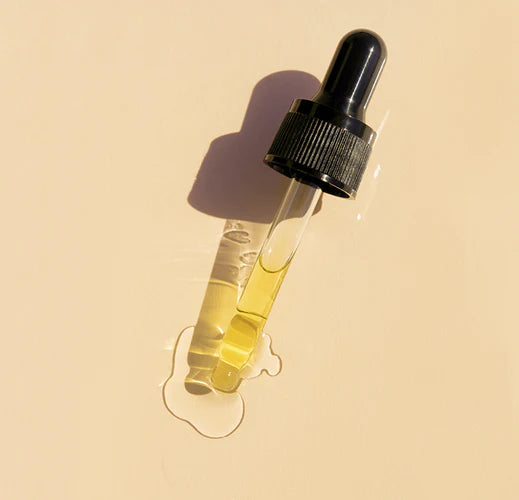

Most exfoliating acids are designed to be rinsed off quickly, used in a clinic, or washed away before they can cause trouble. Leaving an acid on overnight sounds counterintuitive, particularly for sensitive skin. But for lactic acid specifically, an overnight leave-on format is not just safe - it is the most effective way to use it.
Why lactic acid is the right acid for sensitive skin
Not all alpha-hydroxy acids are equivalent. Glycolic acid, the AHA most people know by name, has the smallest molecular size of any acid in its class. That small molecule penetrates the skin quickly and deeply, which explains both its fast visible results and its tendency to cause redness, stinging, and barrier disruption in reactive skin.
Lactic acid has a larger molecular size. It penetrates more gradually, delivering thorough but controlled exfoliation with a significantly lower irritation profile. Dermatologists consistently recommend it as the first AHA for sensitive, dry, or redness-prone skin. A foundational review in the Journal of the American Academy of Dermatology confirmed lactic acid's dual capacity for effective exfoliation and genuine moisturisation.¹
What makes lactic acid genuinely singular is that it is also a component of the skin's natural moisturising factor (NMF), the complex of molecules that keeps the outer layer of skin hydrated and resilient. It exfoliates and draws moisture into the skin at the same time. No other common AHA does this. For dry or sensitive skin types, that dual action is not a bonus feature - it is why lactic acid works where glycolic acid would simply strip.²
What an overnight leave-on format actually does differently
Most lactic acid products are rinse-off: short-contact treatments, wash-off masks, or timed exfoliating pads. The reasoning is caution - shorten contact time, reduce irritation risk. But it also means the acid is washed away before the exfoliation process is complete.
A leave-on overnight peel changes that. The acid works through the night, during the skin's natural repair and regeneration phase, when cell turnover is at its highest. Full contact time means more thorough exfoliation and better results from each use. The formula doing this overnight work, however, needs to be genuinely built for it.
OSKIA Liquid Mask Lactic Acid Micro-Peel: built for overnight use

OSKIA Liquid Mask Lactic Acid Micro-Peel — from £25
Awards: Beauty Bible 2022 Best Facial Exfoliator (Gold), Wardrobe Icons Best Face Exfoliant 2021 and 2020, Beauty Shortlist 2020
The OSKIA Liquid Mask uses lactic acid at 10%, the highest concentration permitted under EU cosmetic legislation, in a leave-on overnight format. Applied at night, left to work, rinsed off in the morning. That combination - maximum strength, leave-on, is genuinely unusual. Most brands either lower the concentration for leave-on use, or reserve maximum strength for rinse-off formats. OSKIA's position is that sensitive skin does not need weaker acid; it needs acid that is properly supported by the surrounding formula.
The Liquid Mask includes mixed molecular weight Hyaluronic Acid for hydration at multiple depths; Niacinamide (Vitamin B3), which has a well-established ability to counteract the transient redness AHAs can cause, making the formula considerably gentler in practice than its strength would suggest³; Pro-Vitamin B5 to soothe and support barrier function; Red Snow and Black Carrot extracts for antioxidant protection; Cactus Stem extract to condition and calm; and MSM as an anti-inflammatory. The result is a formula that works at full acid strength without the rawness that full strength would typically imply. Suitable for all skin types, one to three times a week.
How to use it correctly
Apply the Liquid Mask to clean, dry skin in the evening, after cleansing. Leave it on overnight and rinse off in the morning. Keep the rest of your routine simple on treatment nights, a moisturiser is all you need on top. Do not layer additional exfoliating actives. If you are new to acids, begin once a week and increase as your skin adapts.
Leave-on acids increase photosensitivity, so SPF the following morning is not optional, it is essential.
What results to expect and when
Lactic acid does not produce the dramatic peeling or purging that stronger acids or retinoids can trigger. Results are cumulative. After the first few uses, most people notice softer texture and a more even surface tone. After several weeks, the improvement in skin clarity and overall finish is more pronounced. The skin looks fresher because it is, dead cell buildup is being cleared efficiently, and the formula's hydrating components mean the skin underneath is properly supported.
For women in their 40s and beyond, cell turnover naturally slows and dead cells accumulate at the surface for longer. Regular, well-tolerated acid exfoliation is one of the most evidence-based approaches to improving texture, evening tone, and helping other actives in the routine penetrate and work more effectively.²
Frequently Asked Questions
Can I use a lactic acid overnight peel every night?
No. The Liquid Mask is designed for one to three times a week. Overuse of any AHA, even a gentle one, can disrupt the skin barrier over time. Rest nights are part of what makes the treatment effective rather than depleting.
How is a leave-on peel different from a rinse-off one?
Contact time. A rinse-off peel is removed before the exfoliation process is complete. A leave-on peel works through the night, giving the acid the full time it needs. It also coincides with the skin's nocturnal repair phase, when cell turnover is naturally at its highest.
Will it make my skin peel or flake?
Not visibly, in most cases. This is a micro-peel, not a clinical peel. Exfoliation happens at the cellular level - dead cells shed, texture improves, tone evens. Visible flaking is not expected. If your skin is particularly reactive, start once a week and build slowly.
Is it safe to use lactic acid in summer?
Yes, with the right precautions. AHAs increase UV sensitivity, so SPF every morning after treatment is essential. This applies year-round, but matters more in summer. The product itself can be used in any season.
Can I use this alongside a retinoid?
Yes, but not on the same night. Use them on alternating nights. Both are potent actives and work best when the skin has adequate recovery time between them. Combining them in the same application risks unnecessary barrier disruption.
Clinical references
- Smith WP. "Epidermal and dermal effects of topical lactic acid." J Am Acad Dermatol, 1996.
- Tang SC, Yang JH. "Dual Effects of Alpha-Hydroxy Acids on the Skin." Molecules, 2018.
- Gehring W. "Nicotinic acid/niacinamide and the skin." J Cosmet Dermatol, 2004.