
When we started developing our self-tan products, the brief was simple: make a self-tan we would actually want to use ourselves.
That meant building it the same way we build everything at OSKIA, from the skin's health first, and the cosmetic outcome second.
The problem with most self-tans
Most self-tanning products are designed around a single objective: produce a convincing brown colour. DHA is the active ingredient; everything else in the formula is there to make the product usable, emulsifiers to create a texture, fragrance to cover the DHA smell, a preservative system to keep it stable.
That is a functional approach. It produces a tan. But it does not produce better skin.
In some cases, frequent self-tan use actively works against skin health. High-concentration DHA can be drying. Formulas built around alcohol base dehydrate the stratum corneum. Synthetic fragrance added to cover the DHA odour can sensitise reactive skin over time. The result: people who use self-tan regularly often find their skin looks good in the short term but feels worse over time.
We did not want to build that product.
What we built instead
OSKIA's Adaptive Tan products are built around a Tri-Phase approach: three mechanisms working simultaneously to produce and maintain a natural-looking tan.
Surface DHA provides immediate colour. Micro-encapsulated DHA penetrates deeper for a longer-lasting result. Our Melanin Complex, with Monk's Pepper, Tyrosine and Arginine, stimulates the skin's own melanin production, adding a depth and naturalness to the colour that DHA alone cannot produce.
But the Tri-Phase is only part of the formula.
Around those tanning actives, we have built a full skincare complex:
MSM (methylsulfonylmethane) is OSKIA's founding ingredient, present in every range we make. In the Adaptive Tan, it supports the skin barrier, reduces inflammation and improves the absorption and effectiveness of the other actives. It also means the skin is in better structural condition throughout the tanning process, which directly affects how evenly and how long the result lasts.
Pea Peptides and Amino Acids support skin structure and elasticity. Conditioned skin holds colour more evenly and fades more gracefully than dehydrated skin.
White Tea is a potent antioxidant. DHA produces some level of oxidative activity in the skin as part of the Maillard reaction. White Tea provides antioxidant support throughout that process.
Vitamins C and E work together as a complementary antioxidant pair. Vitamin C is also essential for collagen synthesis, meaning these ingredients are doing structural work at the same time as your tan is developing.
Pro-Vitamin B5 (Panthenol) hydrates and soothes. It reduces the potential for any transient dryness from the DHA and leaves the skin feeling soft rather than tight.
None of these ingredients are in the formula for marketing reasons. They are there because they make the formula work better and because skin in better condition produces a better result.
Why it matters for the tan
This is the point that most self-tan brands do not make clearly enough: the condition of your skin directly affects the quality of your tan.
DHA reacts with amino acids in the dead cells at the skin's surface. The more evenly those cells are distributed (well-hydrated, intact barrier, consistent cell turnover), the more evenly the tan develops. Dry patches absorb more DHA. Compromised areas fade faster. Uneven skin texture produces patchy results no matter how carefully the product is applied.
Conditioning the skin throughout the tanning process is not a bonus. It is how you get a good result.
What this looks like in practice
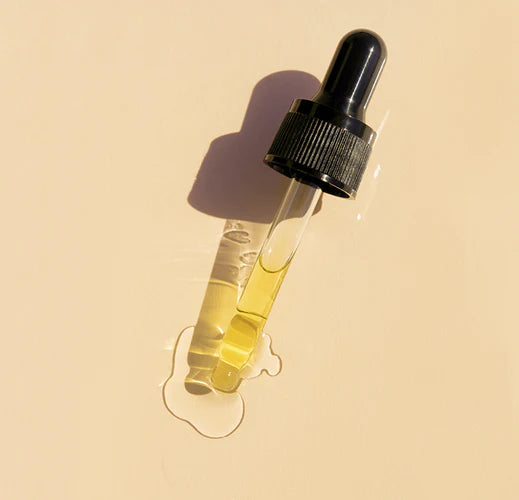
Both Adaptive Tan products can be used every night as part of a skincare routine. The Drops mix into your existing moisturiser or serum, so you are adding tanning actives to a product you are already using. The Mist can be spritzed over the face and body without rubbing in.
Neither product has the disproportionately strong DHA smell that characterises most self-tanners, because the encapsulated DHA is not reacting until it reaches the skin. And because the formula is actively conditioning the skin throughout, the results hold better and fade more evenly.
This is what it means to build a self-tan as a skincare brand. Not to add a few cosmetic ingredients to a DHA base, but to design the formula around what the skin needs, and let the tan follow from that.
Adaptive Tan Drops (15ml) and Adaptive Tan Mist (100ml) are available at oskiaskincare.com.