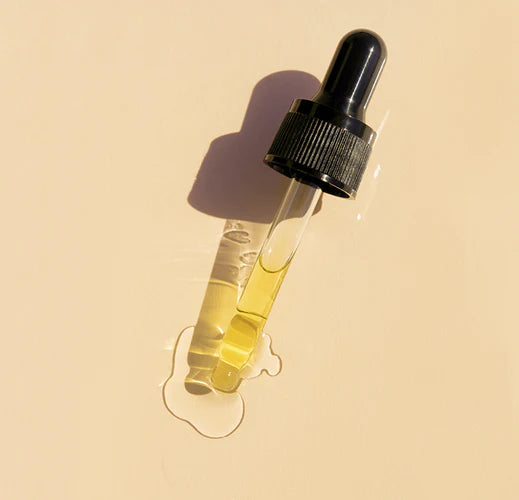

Lactic acid appears on more product labels than almost any other exfoliating active. It is widely used and frequently misunderstood, described as "the gentle one" without any real explanation of why. The reason it is gentle matters, because it is also the reason it does something no other acid can.
What lactic acid actually is
Lactic acid is an alpha-hydroxy acid (AHA), naturally derived from milk or produced via plant fermentation, and one of the most extensively studied cosmetic actives in the literature. Its primary function is exfoliation: it breaks the chemical bonds between dead skin cells at the surface of the stratum corneum, allowing them to shed more easily. The result is a fresher surface, improved texture, and better penetration for the rest of your routine. That mechanism is shared by all AHAs.
What makes lactic acid singular is something else. It is also a component of the skin's natural moisturising factor (NMF), the complex of water-binding molecules that keeps the outer layer hydrated and intact. Because lactic acid is already part of the skin's own hydration system, it draws moisture in while it exfoliates. No other common AHA does this. Glycolic acid exfoliates. Lactic acid exfoliates and hydrates simultaneously - which is why it occupies a different category for dry and sensitive skin.¹
How glycolic acid compares
Glycolic acid is derived from sugar cane. Its small molecular size - the smallest of any AHA - allows it to penetrate quickly and deeply, producing fast visible results. That is its strength. Its limitation is the same mechanism: redness, stinging, peeling, and barrier compromise are more common with glycolic acid than with any other AHA, particularly in sensitive or dry skin.
Lactic acid penetrates more gradually. Results build steadily rather than dramatically, but with a significantly lower irritation profile. Dermatologists consistently recommend it as the starter AHA because it delivers real, proven results while keeping the barrier intact.² For skin in its 40s, 50s and 60s, where barrier resilience is naturally lower, that is not a minor distinction.
How lactic acid compares to other AHAs and BHAs
Understanding where lactic acid sits within the broader acid landscape helps clarify which tool to reach for and when.
| Acid | Type | Molecular Size | Best For | Caution Level |
|---|---|---|---|---|
| Lactic | AHA | Large | Sensitive, dry, mature skin | Low |
| Glycolic | AHA | Small | All skin, faster results | Medium |
| Mandelic | AHA | Largest | Hyperpigmentation, darker skin tones | Very Low |
| Salicylic | BHA | Oil-soluble | Acne, congested pores | Low–Medium |
Mandelic acid has the largest molecular size of any AHA, penetrates most slowly, and is well suited to hyperpigmentation - particularly in darker skin tones where other acids risk triggering post-inflammatory hyperpigmentation.
Salicylic acid is a beta-hydroxy acid (BHA), oil-soluble rather than water-soluble. That solubility lets it penetrate into the pore lining and clear congestion from inside the follicle - something no AHA can do. It is the right tool for oily, acne-prone skin, not the first choice for dry or mature skin.³
What lactic acid does for mature and sensitive skin specifically
For women in their 40s and beyond, cell turnover slows and dead cells accumulate at the surface for longer. That accumulation is a primary driver of dull tone and rough texture. Regular acid exfoliation addresses it efficiently.
Barrier resilience also declines with age, and oestrogen decline affects the skin's ability to retain moisture and recover from disruption. An exfoliant that hydrates while it exfoliates without compromising the barrier is the intelligent approach. Forcing more disruption with a stronger acid is unnecessary and, in mature skin, counterproductive. Clinical evidence confirms lactic acid's effectiveness for both exfoliation and moisturisation, with a tolerability profile suited to consistent use.¹
OSKIA Liquid Mask: maximum-strength lactic acid in an overnight format

OSKIA Liquid Mask Lactic Acid Micro-Peel - from £25
Awards: Beauty Bible 2022 Best Facial Exfoliator (Gold), Wardrobe Icons Best Face Exfoliant 2021 and 2020, Beauty Shortlist 2020
OSKIA chose lactic acid for the Liquid Mask because its profile aligns with the brand's approach: working with the skin's own biology rather than forcing disruption. The formula uses lactic acid at 10%, the maximum concentration permitted under EU cosmetic legislation, in a leave-on overnight format. Most leave-on acid products use lower concentrations; maximum-strength formulas are typically reserved for rinse-off treatments. The overnight contact time allows the exfoliation process to complete during the skin's natural repair phase rather than being interrupted by rinsing.
Supporting ingredients - Niacinamide (Vitamin B3) to counteract AHA-related redness and even tone, mixed molecular weight Hyaluronic Acid for multi-depth hydration, Pro-Vitamin B5 to soothe, and MSM as an anti-inflammatory — make maximum-strength overnight use achievable for sensitive skin. That is intelligent skin nutrition in practice: understanding what the skin needs and building a formula that delivers it without unnecessary disruption.
Frequently Asked Questions
Which is more effective, lactic acid or glycolic acid?
It depends on what you mean by effective. Glycolic acid produces faster visible change because it penetrates more deeply. Lactic acid produces consistent, reliable improvement with considerably less irritation, and uniquely hydrates while it exfoliates. For sensitive, dry, or mature skin, lactic acid is the more effective choice in practice - because it is the one you can use consistently without barrier disruption. Consistent use of a gentler acid always outperforms sporadic use of a stronger one.
Can I use lactic acid every day?
Most skin types do better with two to three times a week. Skin needs recovery time between acid applications to maintain a healthy barrier. For a high-strength product like the OSKIA Liquid Mask, one to three times a week is the right range; adjust based on how your skin responds.
Can I use lactic acid and glycolic acid together?
Not in the same application. Layering AHAs increases the total acid load without a proportional increase in benefit, and raises the risk of barrier disruption. If you want to use both, alternate them on different nights. In most cases, choosing one acid and using it consistently delivers better results than rotating between several.
Is lactic acid suitable for rosacea?
Proceed with caution. Any exfoliating active can trigger a flare in rosacea-prone skin. Lactic acid is the gentlest common AHA, and niacinamide in formulas like the OSKIA Liquid Mask adds calming support - but if your rosacea is active or reactive, introduce any acid gradually and ideally with dermatologist guidance.
What strength lactic acid should a beginner use?
Around 5% is a sensible starting point; build tolerance before moving higher. That said, the supporting formula matters as much as the concentration. A well-formulated 10% with barrier-supporting and calming ingredients can be more appropriate for sensitive skin than a poorly formulated lower-strength product. Look at the full ingredient list, not just the percentage.
Clinical references
- Smith WP. "Epidermal and dermal effects of topical lactic acid." J Am Acad Dermatol, 1996.
- Tang SC, Yang JH. "Dual Effects of Alpha-Hydroxy Acids on the Skin." Molecules, 2018.
- Van Scott EJ, Yu RJ. "Alpha hydroxy acids: procedures for use in clinical practice." Cutis, 1989.