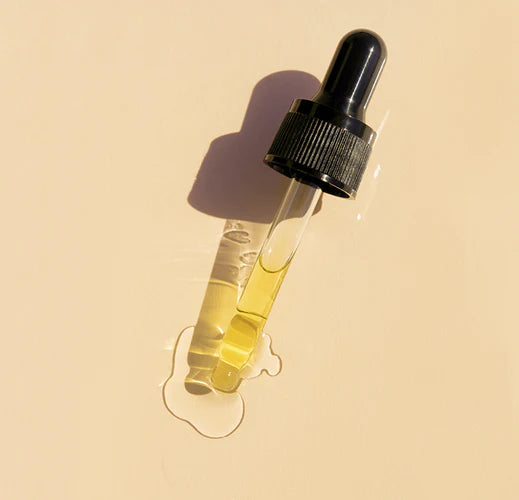

Vitamin C is one of the most researched actives in skincare, yet it divides opinion like few other ingredients. Ask a cosmetic chemist and you will likely get a different answer to the one you find on a beauty blog. The core question is this: does the form of vitamin C you are using actually matter, or is all vitamin C created equal? The answer, it turns out, has real consequences for your skin.
The case for L-ascorbic acid
L-ascorbic acid (LAA) is the form that most people mean when they say "vitamin C." It is the most extensively researched topical antioxidant in dermatology and has a well-established track record for brightening skin tone, defending against free radical damage, and supporting collagen synthesis. Research confirmed measurable percutaneous absorption of L-ascorbic acid and documented its antioxidant effects in human skin.1
The problem with LAA is not its activity. The problem is its chemistry. LAA is water-soluble and highly unstable. It oxidises rapidly on exposure to air and light, which means that the serum sitting on your bathroom shelf may have lost a significant portion of its potency by the time you open it. To remain stable in a formula, LAA must be kept at a very low pH, typically between 2.5 and 3.5. That level of acidity is effective at penetrating the outer layers of skin, but it comes with a cost: stinging, redness and irritation are common, particularly for those with sensitive or mature skin whose barrier function is already more reactive.
What is ascorbyl tetraisopalmitate, and why does it behave differently?
Ascorbyl tetraisopalmitate (ATIP) is a lipophilic ester of vitamin C. In plain terms, the vitamin C molecule has been esterified with a fatty acid chain, making it oil-soluble rather than water-soluble. This single structural difference changes almost everything about how the ingredient performs in a formula and on skin.
Because ATIP is fat-soluble, it moves through the lipid bilayer of skin cells far more readily than LAA. The skin's architecture is largely lipid-based, so an oil-soluble vitamin C is working with the skin's own structure rather than against it. ATIP is also pH-neutral, meaning there is no requirement for an acidic formulation base. The result is a vitamin C that delivers without the sting.
Stability is the other critical factor. Research into the stability of vitamin C derivatives in topical formulations has consistently shown that esterified forms are far more resistant to oxidation than free L-ascorbic acid.2 ATIP does not degrade rapidly on exposure to air or light, which means a well-formulated product retains its potency for significantly longer.
The collagen question: which form does more?
This is where the science becomes genuinely interesting. The conventional wisdom is that LAA, being the "pure" form, must be the most effective. The clinical data suggests otherwise, at least when it comes to collagen synthesis.
Studies have shown that ATIP stimulates significantly higher levels of collagen production in human dermal fibroblasts compared to L-ascorbic acid at equivalent doses. The likely explanation is delivery efficiency: an oil-soluble molecule that penetrates the lipid bilayer more readily is able to reach the fibroblasts where collagen synthesis actually occurs, rather than remaining at the skin's surface or degrading before it gets there.3 Stability reinforces this effect.
Why the delivery format matters as much as the ingredient
A vitamin C product is only as good as its ability to get the active ingredient into the skin in an effective form. OSKIA Super C is formulated as an oil-based serum and comes in individual single-dose seaweed capsules, each containing high-strength ATIP. The encapsulation prevents any oxidation from occurring before the moment of use. You break open one capsule per application, and the formula inside is as potent as the day it was made.
The formula also contains tocotrienols (the most bioavailable form of vitamin E, which works synergistically with vitamin C as an antioxidant), phytosterols to support barrier function, squalane derived from sugar cane, jojoba oil and sweet almond oil. The capsules are biodegradable and compostable. Super C is available in packs of 60 capsules.
Who should choose ATIP over LAA?
The honest answer is that most people will benefit from ATIP, and a specific group will benefit considerably more. If you have ever tried a vitamin C serum and experienced redness, tingling or irritation, the culprit is almost certainly the low pH required to stabilise L-ascorbic acid, not vitamin C itself. ATIP removes that variable entirely. It is pH-neutral and oil-soluble, making it well tolerated by sensitive, reactive and mature skin types.
If you have tried a vitamin C product and suspect it has degraded before you finished the bottle (the telltale sign is an orange or brown discolouration), the single-dose encapsulation model is a direct solution to that problem.
Frequently asked questions
Does vitamin C in oil really work as well as a water-based serum?
For an oil-soluble form like ATIP, an oil-based vehicle is not a compromise - it is the correct vehicle. ATIP is lipophilic by design, meaning it is built to penetrate via a fat-soluble pathway. An oil-based formula enhances that delivery rather than hindering it.
Can I use Super C on sensitive skin?
Yes. Because ATIP is pH-neutral, it does not require the acidic formulation base that makes L-ascorbic acid serums a problem for sensitive skin. Many people who have given up on vitamin C entirely due to irritation find they tolerate ATIP-based formulas well.
Can I use Super C alongside a retinoid?
Yes. Unlike L-ascorbic acid, which is best used separately from retinoids due to pH interactions, ATIP is pH-neutral and does not present the same compatibility issue. You can use Super C in the morning and a retinoid in the evening without the formulation conflict that applies to LAA.
How do I know if my vitamin C product has oxidised?
L-ascorbic acid products oxidise visibly: the formula turns from pale yellow or clear to a deeper amber, orange or brown. If your vitamin C serum has darkened significantly since you opened it, the active has oxidised and the product has lost much of its efficacy. With ATIP in single-dose capsules, this is not a consideration.
1. Pinnell SR, et al. "Topical L-ascorbic acid: percutaneous absorption studies." Dermatological Surgery, 2001.
2. Stamford NPJ. "Stability, transdermal penetration, and cutaneous effects of ascorbic acid and its derivatives." Journal of Cosmetic Dermatology, 2012.
3. Geesin JC, et al. "Regulation of collagen synthesis in human dermal fibroblasts by the sodium and magnesium salts of ascorbyl-2-phosphate." Skin Pharmacology, 1993.